Statins, Cholesterol and the Internet: Seperating Fact from Fiction
Cholesterol is a hot button topic. The most common medication we use to treat high cholesterol is a class of medication called the statins, like Simvastatin or Atorvastatin. These medications have been used for a long time, are well researched, and are very commonly used - most doctors are pretty comfortable with them.
But I've realized recently that statins kind of have a bad rep among patients. Many patients are hesitant to start on them, or come with a lot of questions or concerns. Mostly because of a common side effect of muscle aches and pains, which some people can find quite uncomfortable.
But the other day a patient brought up to me:
"I've heard statins can cause dementia..."
I have to admit - that was a question I hadn't really encountered before. It sent me down an unexpected research rabbit hole, and it reminded me of something that is increasingly important in modern medicine:
Good healthcare isn't just about having access to information. It's about knowing how to interpret it.
Cholesterol isn't the enemy
Firstly, I'd like to clear up a big misconceptions is that cholesterol itself is "bad."
In reality, cholesterol is essential for life.
Your body uses it to:
Build healthy cell membranes
Produce hormones such as oestrogen and testosterone
Make vitamin D
Produce bile acids to digest fats
The problem isn't cholesterol itself. The problem is too much LDL cholesterol ("bad cholesterol") circulating in the bloodstream, which can gradually build up inside artery walls.
Over many years, these fatty deposits (plaques) can narrow or block arteries, leading to:
❤️ Heart attacks
🧠 Strokes
🦵Vascular disease and poor circulation
For most people, high cholesterol causes no symptoms at all—until a serious cardiovascular event occurs.
That's why we call it a "silent killer".
Preventing these serious cardiovascular events is much better than trying to correct for the damage afterwards.
That's why doctors are so focused on cholesterol control.
Lifestyle comes first
One thing I always tell my patients is this:
There is no tablet that can replace a healthy lifestyle.
For many people, improving diet, exercising regularly, maintaining a healthy weight, avoiding smoking and controlling blood pressure can make a significant difference. These lifestyle changes don't just improve cholesterol—they reduce the risk of diabetes, heart disease, stroke and even dementia. But unfortunately, making drastic lifesetyle changes can be easier said than done. And sometimes you can do everything right and it still isn't enough. Some people inherit high cholesterol through their genes. Others already have established cardiovascular disease.
That's where medication becomes an important tool.
Why do we prescribe statins?
Statins are among the most extensively studied medications we have.
They work by reducing the liver's production of LDL cholesterol, helping to slow—or even stabilise—the build-up of plaque in arteries.
For people at increased cardiovascular risk, statins have consistently been shown to reduce:
Heart attacks
Strokes
The need for bypass surgery or stents
Death from cardiovascular disease
For someone who has already had a heart attack or stroke, the evidence is overwhelming. The benefits are substantial.
But aren't statins dangerous?
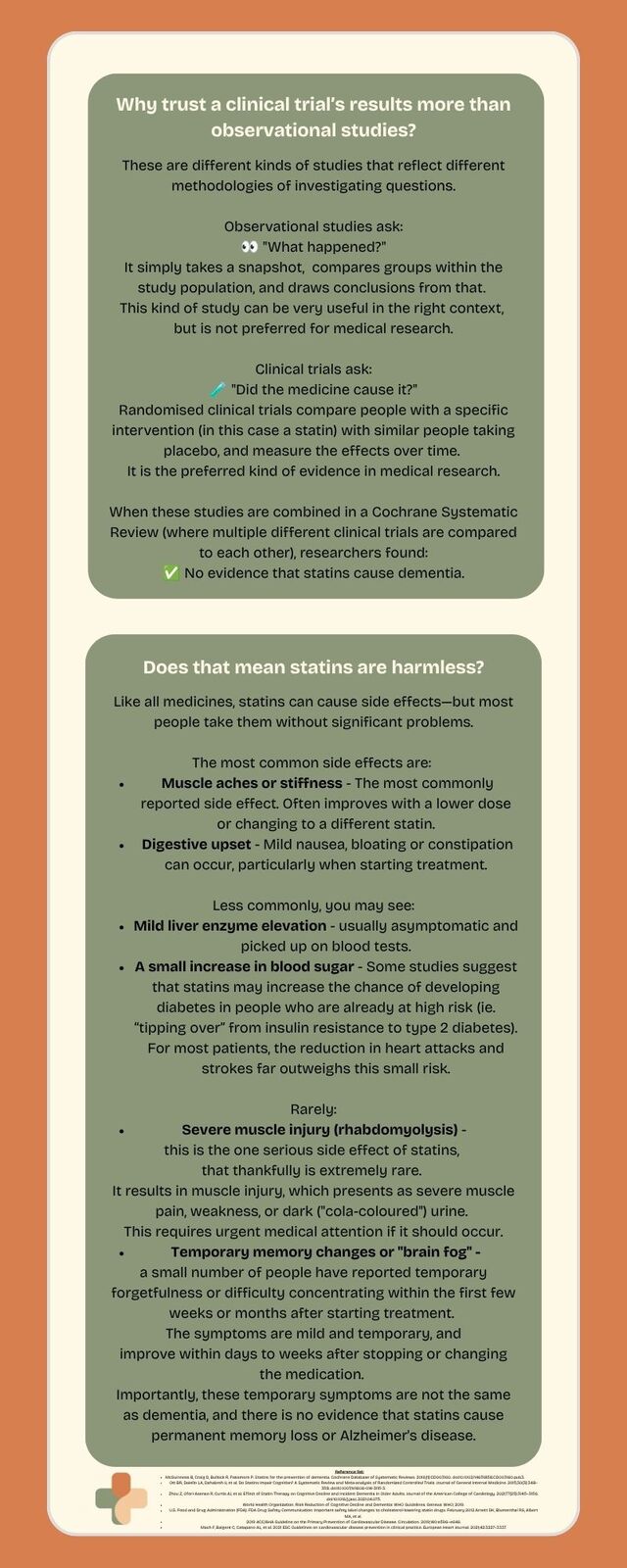
Like every medication, statins have potential side effects.
The most common are muscle aches or stiffness. Some people develop mild digestive symptoms. A small increase in blood sugar has also been recognized in people already at risk of diabetes. Fortunately, serious side effects are uncommon, and most people tolerate statins extremely well.
If side effects do occur, changing the dose or switching to another statin often solves the problem.
The one serious side effect they can have, is something called rhabdomyolysis - damage to the muscles, resulting in breakdown of protein and kidney damage. Thankfully this is a very, very rare.
The question that started my research...
During a consultation recently, a patient asked:
"Doctor... I've heard statins can cause dementia. Is that true?"
It's an understandable concern.
After all, memory loss is something many of us fear as we get older.
The interesting thing is that this question perfectly illustrates how medical science works.
When headlines don't tell the whole story
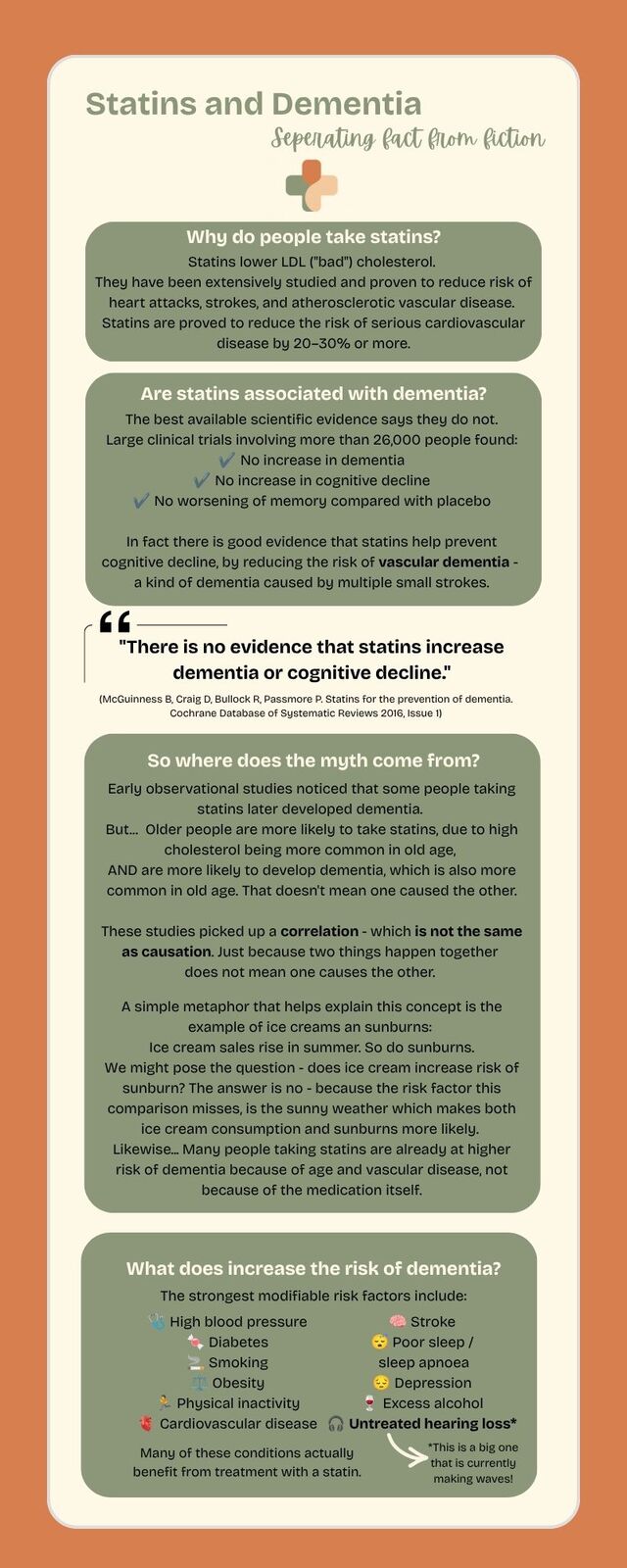
Years ago, some observational studies noticed that people taking statins also seemed to develop dementia.
At first glance, that sounds concerning. But observational studies can only tell us that two things happened together.
They cannot tell us whether one caused the other.
This is one of the most important ideas in medical research:
Correlation does not equal causation.
I like the metaphor of ice cream and sunburn to help illustrate this concept.
In South Africa in December, ice cream sales soar. So do sunburns. So we can pose a question - does ice cream increase your risk of sunburn?
We know that the answer to that is no. Because the risk factor this comparison misses, is the sunny weather which makes both ice cream consumption and sunburns more likely.
And people taking statins are generally older and have conditions like high blood pressure, diabetes and vascular disease—all of which independently increase the risk of dementia.
Following the evidence
To answer that question the observational studies posed, researchers turned to randomized controlled trials — the gold standard of medical research.
Thousands of people were randomly assigned to receive either a statin or a placebo and followed over many years.
When these studies were combined in a Cochrane Systematic Review, involving more than 26,000 participants, researchers found:
✔ No evidence that statins increase dementia.
✔ No evidence that statins worsen cognitive function.
✔ No evidence of long-term memory decline compared with placebo.
A very small number of people have reported temporary "brain fog" after starting a statin, but these reports are rare, mild, reversible, and importantly, are not the same as dementia.
Are statins the only option?
Not always.
Treatment depends on the individual.
For people who cannot tolerate statins—or who need additional cholesterol lowering — we do have alternatives such as Ezetimibe, or a class of medications called Fibrates, that decrease your triglyceride levels. The right treatment depends on your overall cardiovascular risk, cholesterol profile and medical history. And lifestyle will always play a big role in optimizing your cardiovascular health.
My biggest takeaway
Researching this topic reminded me why I love medicine.
Questions from patients don't just help the individual sitting in front of me—they often send me back to the evidence, deepen my understanding, and ultimately make me a better doctor.
The story of statins is also the story of evidence-based medicine.
A question was raised.
Researchers investigated it.
More studies, better suited to answering the question, were performed.
The answer became clearer.
And today, after decades of research involving hundreds of thousands of patients, we can say with confidence that statins remain one of the most effective and well-studied medications we have for preventing heart attacks and strokes.
As with every treatment, they are not right for everyone.
But they deserve to be judged on good science—not internet myths.
If you have questions about cholesterol, statins, or your own cardiovascular risk, don't hesitate to ask. Some of the best conversations in medicine begin with a simple question.