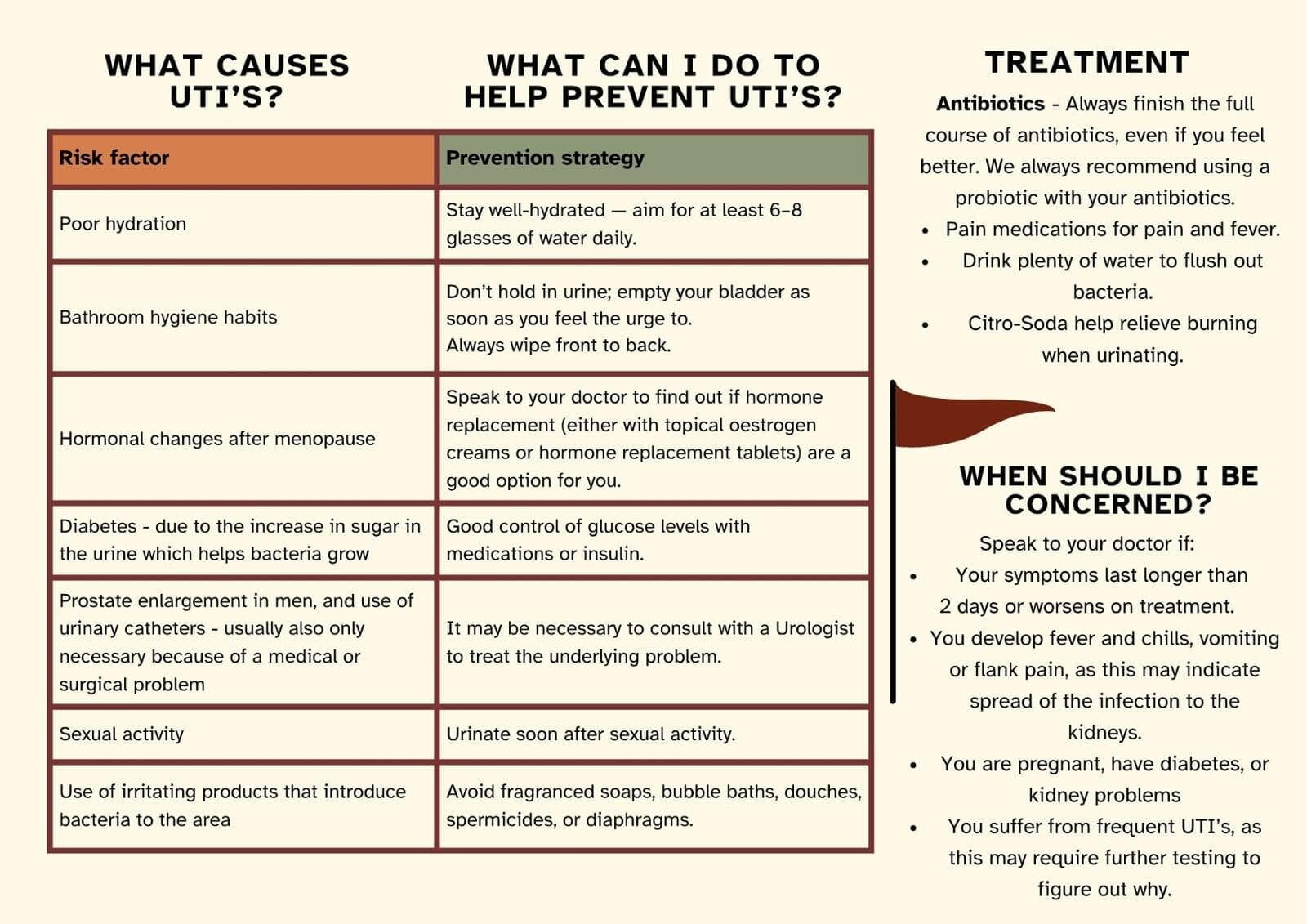
Urinary tract infections (UTIs) is an incredibly common issue in general practice, affecting millions of people every year—particularly women. Although they can be very uncomfortable, they are usually easy to treat when diagnosed early.
UTI's do occur more frequently in women than men, because the female urethra is much shorter. This means bacteria have a much shorter distance to travel before reaching the bladder. However, UTIs can occur in anyone, including men and children.
We often find that patients may feel uncomfortable speaking the symptoms of a urinary tract infection. But it is important to understand that getting a UTI is nota sign that you're "unclean," have poor personal hygiene, or are sexually promiscuous. In fact, many factors that increase the risk of UTI's are completely outside of your control: your anatomy, hormonal changes after menopause, pregnancy, diabetes, certain medications, kidney stones, or simply being prone to recurrent infections.
If you're experiencing symptoms, don't suffer in silence or feel embarrassed to seek help. It's exactly the kind of problem your GP is here to help with, and with the right treatment, most people recover quickly and without complication.
If you're experiencing symptoms, don't suffer in silence or feel embarrassed to seek help. It's exactly the kind of problem your GP is here to help with, and with the right treatment, most people recover quickly and without complication.
What is a urinary tract infection?
A urinary tract infection is a bacterial infection of the urinary system, which includes the kidneys, ureters, bladder and urethra.
Most UTIs involve the bladder (known as cystitis) and the urethra. If left untreated, however, the infection can spread to the kidneys, causing a more serious infection called pyelonephritis.
The vast majority of UTIs are caused by bacteria that normally live in the bowel. These bacteria can enter the urinary tract through the urethra and multiply inside the bladder.
A urinary tract infection is a bacterial infection of the urinary system, which includes the kidneys, ureters, bladder and urethra.
Most UTIs involve the bladder (known as cystitis) and the urethra. If left untreated, however, the infection can spread to the kidneys, causing a more serious infection called pyelonephritis.
The vast majority of UTIs are caused by bacteria that normally live in the bowel. These bacteria can enter the urinary tract through the urethra and multiply inside the bladder.
What are the symptoms?
A bladder infection may cause symptoms such as:
Burning or pain when passing urine
Needing to urinate more often than usual
Feeling an urgent need to pass urine
Cloudy, strong-smelling or blood-tinged urine
Lower abdominal discomfort
Feeling tired or generally unwell
Occasionally nausea or vomiting
A bladder infection may cause symptoms such as:
Burning or pain when passing urine
Needing to urinate more often than usual
Feeling an urgent need to pass urine
Cloudy, strong-smelling or blood-tinged urine
Lower abdominal discomfort
Feeling tired or generally unwell
Occasionally nausea or vomiting
When does a UTI become serious?
If bacteria spread from the bladder to the kidneys, symptoms become much more severe and may include:
Fever and chills
Pain in the back or sides (flank pain)
Vomiting
Feeling significantly unwell
A kidney infection requires prompt medical assessment and treatment.
If bacteria spread from the bladder to the kidneys, symptoms become much more severe and may include:
Fever and chills
Pain in the back or sides (flank pain)
Vomiting
Feeling significantly unwell
A kidney infection requires prompt medical assessment and treatment.
How do we diagnose a UTI?
In most cases, we'll ask you to provide a urine sample during your consultation.
A urine dipstick test can detect signs of infection such as white blood cells, blood, protein and nitrites.
Depending on your symptoms and medical history, we may also send your urine to the laboratory for a culture, which identifies the bacteria causing the infection and determines which antibiotics are most effective. This also helps us identify UTI's caused by antibiotic-resistant bacteria, and successfully treat these infections with targeted antibiotics.
In most cases, we'll ask you to provide a urine sample during your consultation.
A urine dipstick test can detect signs of infection such as white blood cells, blood, protein and nitrites.
Depending on your symptoms and medical history, we may also send your urine to the laboratory for a culture, which identifies the bacteria causing the infection and determines which antibiotics are most effective. This also helps us identify UTI's caused by antibiotic-resistant bacteria, and successfully treat these infections with targeted antibiotics.
How is a UTI treated?
Treatment usually includes:
Antibiotics to clear the infection
Completing the full antibiotic course, even if you feel better after a day or two
Drinking plenty of water to help keep you hydrated
Pain medication if needed for discomfort or fever
Taking a probiotic while using antibiotics, as we routinely recommend
Citro-Soda may help relieve the burning sensation while passing urine, although it does not treat the infection itself.
Most people notice improvement within 24–48 hours after starting antibiotics.
Treatment usually includes:
Antibiotics to clear the infection
Completing the full antibiotic course, even if you feel better after a day or two
Drinking plenty of water to help keep you hydrated
Pain medication if needed for discomfort or fever
Taking a probiotic while using antibiotics, as we routinely recommend
Citro-Soda may help relieve the burning sensation while passing urine, although it does not treat the infection itself.
Most people notice improvement within 24–48 hours after starting antibiotics.
Can UTIs be prevented?
While it's not always possible to prevent a UTI, there are several habits that can significantly reduce your risk.
While it's not always possible to prevent a UTI, there are several habits that can significantly reduce your risk.
Stay well hydrated
Drinking enough water helps flush bacteria out of the urinary tract.
Aim for around 6–8 glasses of water each day, unless your doctor has advised otherwise.
Drinking enough water helps flush bacteria out of the urinary tract.
Aim for around 6–8 glasses of water each day, unless your doctor has advised otherwise.
Don't hold your urine
Empty your bladder as soon as you feel the urge to go, rather than delaying. Regular bladder emptying helps prevent bacteria from multiplying.
Empty your bladder as soon as you feel the urge to go, rather than delaying. Regular bladder emptying helps prevent bacteria from multiplying.
Practise good bathroom hygiene
Always wipe from front to back after using the toilet. This reduces the chance of bacteria from the bowel reaching the urinary tract.
Always wipe from front to back after using the toilet. This reduces the chance of bacteria from the bowel reaching the urinary tract.
Urinate after sexual activity
Passing urine soon after intercourse may help flush bacteria from the urethra and lower the risk of infection.
Passing urine soon after intercourse may help flush bacteria from the urethra and lower the risk of infection.
Avoid irritating products
Fragranced soaps, bubble baths, douches, spermicides and diaphragms may increase irritation or alter the normal balance of bacteria around the urinary tract.
Fragranced soaps, bubble baths, douches, spermicides and diaphragms may increase irritation or alter the normal balance of bacteria around the urinary tract.
Manage underlying medical conditions
Certain medical conditions increase the risk of recurrent UTIs.
These include:
Diabetes
In men: an enlarged prostate
Long-term urinary catheters
In women: hormonal changes after menopause
Managing these underlying conditions—and, where appropriate, discussing options such as topical oestrogen after menopause—can help reduce recurrent infections.
Certain medical conditions increase the risk of recurrent UTIs.
These include:
Diabetes
In men: an enlarged prostate
Long-term urinary catheters
In women: hormonal changes after menopause
Managing these underlying conditions—and, where appropriate, discussing options such as topical oestrogen after menopause—can help reduce recurrent infections.
Menopause and recurrent UTIs
Many women notice that they begin experiencing frequent UTIs after menopause. This is because declining oestrogen levels cause the tissues of the vagina and urethra to become thinner, drier and more fragile—a condition known as genitourinary syndrome of menopause (GSM) or atrophic vaginitis.
These changes also reduce the number of healthy bacteria (particularly Lactobacillus) that normally help protect against infection. As a result, harmful bacteria can more easily grow and enter the urinary tract. If you're experiencing recurrent UTIs after menopause, treating the underlying vaginal changes can be just as important as treating the infections themselves.
For many women, topical vaginal oestrogen (available as a cream, tablet or pessary) is one of the most effective ways to reduce recurrent UTIs. It helps restore the health of the vaginal and urethral tissues, improves the natural protective bacteria, and lowers the risk of future infections. Because it is applied locally, only a very small amount is absorbed into the bloodstream, making it a safe and effective option for many postmenopausal women.
If you are postmenopausal and find yourself needing repeated courses of antibiotics for UTIs, speak to your GP. You may benefit from an assessment for atrophic vaginitis and discussion about whether vaginal oestrogen therapy is appropriate for you.
Many women notice that they begin experiencing frequent UTIs after menopause. This is because declining oestrogen levels cause the tissues of the vagina and urethra to become thinner, drier and more fragile—a condition known as genitourinary syndrome of menopause (GSM) or atrophic vaginitis.
These changes also reduce the number of healthy bacteria (particularly Lactobacillus) that normally help protect against infection. As a result, harmful bacteria can more easily grow and enter the urinary tract. If you're experiencing recurrent UTIs after menopause, treating the underlying vaginal changes can be just as important as treating the infections themselves.
For many women, topical vaginal oestrogen (available as a cream, tablet or pessary) is one of the most effective ways to reduce recurrent UTIs. It helps restore the health of the vaginal and urethral tissues, improves the natural protective bacteria, and lowers the risk of future infections. Because it is applied locally, only a very small amount is absorbed into the bloodstream, making it a safe and effective option for many postmenopausal women.
If you are postmenopausal and find yourself needing repeated courses of antibiotics for UTIs, speak to your GP. You may benefit from an assessment for atrophic vaginitis and discussion about whether vaginal oestrogen therapy is appropriate for you.
When should you see your doctor for a UTI?
You should seek medical attention if:
Your symptoms persist for more than two days.
Your symptoms worsen despite treatment.
You develop fever, chills, vomiting or pain in your back or sides.
You are pregnant.
You have diabetes or kidney disease.
You experience frequent or recurrent UTIs.
Early assessment helps ensure the correct diagnosis and treatment, while reducing the risk of complications.
You should seek medical attention if:
Your symptoms persist for more than two days.
Your symptoms worsen despite treatment.
You develop fever, chills, vomiting or pain in your back or sides.
You are pregnant.
You have diabetes or kidney disease.
You experience frequent or recurrent UTIs.
Early assessment helps ensure the correct diagnosis and treatment, while reducing the risk of complications.
The bottom line
UTIs are common, but they shouldn't be ignored. Most infections respond quickly to treatment, especially when diagnosed early. If you're experiencing burning when passing urine, needing to go more frequently, or any of the symptoms discussed above, book an appointment with your GP.
A simple urine test can usually confirm the diagnosis, allowing treatment to start promptly and helping you get back to feeling your best.
UTIs are common, but they shouldn't be ignored. Most infections respond quickly to treatment, especially when diagnosed early. If you're experiencing burning when passing urine, needing to go more frequently, or any of the symptoms discussed above, book an appointment with your GP.
A simple urine test can usually confirm the diagnosis, allowing treatment to start promptly and helping you get back to feeling your best.